
Why Air Quality in Your Bedroom Matters More Than You Think
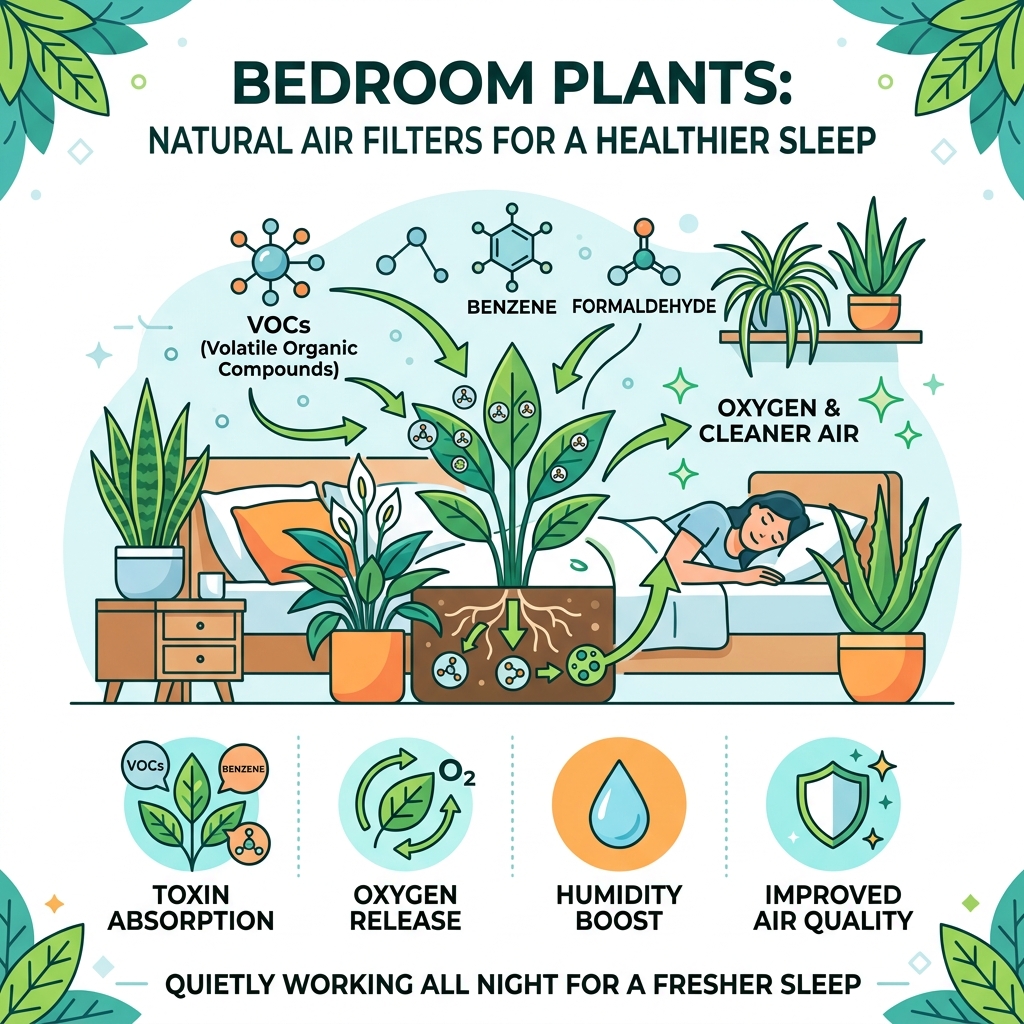
Air cleaning plants for bedroom spaces are one of the simplest, most affordable ways to breathe better while you sleep. Here are the top options, backed by NASA research:
| Plant | Key Benefit | Light Needs | Pet Safe? |
|---|---|---|---|
| Snake Plant | Releases oxygen at night | Low to bright indirect | No |
| Peace Lily | Removes benzene, ammonia | Low light | No |
| Spider Plant | Filters formaldehyde | Indirect light | Yes |
| Aloe Vera | Removes VOCs, nighttime O2 | Bright indirect | No |
| Areca Palm | Boosts humidity, filters toxins | Bright indirect | Yes |
| English Ivy | Removes airborne mold | Indirect light | No |
| Boston Fern | Humidifies, filters pollutants | Indirect light | Yes |
Most people spend 7-9 hours a night in their bedroom. That’s a long time to breathe stale, polluted air.
And indoor air is often more polluted than outdoor air. Furniture, mattresses, cleaning products, and paint all release chemicals called volatile organic compounds (VOCs) — things like formaldehyde, benzene, and xylene — directly into your sleeping space.
NASA’s landmark 1989 Clean Air Study found that common houseplants can absorb these toxins and genuinely improve indoor air quality. Dr. Bill Wolverton, the NASA senior research scientist who led the study, concluded that indoor plants can be a very effective part of creating a pollution-free home.
The right plant on your nightstand isn’t just decoration. It’s quietly working all night.
Top NASA-Backed Air Cleaning Plants for Bedroom Spaces
When we talk about the best air cleaning plants for bedroom use, we aren’t just picking pretty leaves. We are looking for “botanical guardians” that have been scientifically vetted. NASA’s research into closed environments (like space stations!) proved that certain plants are powerhouses at scrubbing the air of toxins.

Snake Plant (Dracaena trifasciata)
The undisputed champion of the bedroom is the Snake Plant. Often called “Mother-in-Law’s Tongue” because of its sharp, pointed leaves, this plant is nearly indestructible. According to a detailed review on Sansevieria Trifasciata: A Low-Maintenance, Air-Purifying Plant for Improved Indoor Health, it is exceptionally efficient at removing formaldehyde, benzene, and nitrogen oxides. It’s the perfect “set it and forget it” plant for busy people.
Peace Lily (Spathiphyllum)
If you want something that blooms, the Peace Lily is a top contender. It doesn’t just look elegant; it’s a high-performance filter. We’ve previously discussed peace-lilies-and-their-contribution-to-better-air-quality, noting its ability to break down carbon monoxide and formaldehyde. Just keep in mind that these lilies love a bit of humidity and will “droop” dramatically when they need a drink—it’s like they have a built-in thirst alarm!
Spider Plant (Chlorophytum comosum)
The Spider Plant is a classic for a reason. It’s incredibly resilient and safe for your furry friends. In our guide on air-purifying-plants-for-your-bedroom, we highlight its ability to battle xylene and formaldehyde, which are often found in the adhesives used in bedroom furniture. Plus, they produce “spiderettes” (baby plants) that you can easily propagate to fill every room in your house.
Aloe Vera
Known for its skin-soothing gel, Aloe Vera is also a silent air scrubber. It helps clear the air of benzene and formaldehyde. A fun tip: if the leaves develop brown spots, it’s often a sign that the chemical levels in your room are high, making it a natural air quality monitor!
English Ivy (Hedera helix)
If you struggle with allergies, English Ivy might be your new best friend. Research from the University of Georgia suggests it can remove up to 58% of airborne mold particles in just a few hours. This makes it a fantastic choice for damp bedrooms or older homes where mold might be a hidden guest.
Why the Snake Plant is the Best Air Cleaning Plant for Bedroom Oxygen
Most plants are “day shift” workers. They take in CO2 and release oxygen during the day through photosynthesis, but at night, they actually flip the script and release small amounts of CO2.
The Snake Plant, however, is a “night owl.” It uses a specialized process called Crassulacean Acid Metabolism (CAM). This means it keeps its pores (stomata) closed during the day to conserve water and opens them at night to take in CO2 and release fresh oxygen.
By increasing the oxygen levels in your room while you sleep, the Snake Plant helps create an optimal environment for deep rest. This unique trait is why many experts consider it the single best air cleaning plants for bedroom oxygen production.
Peace Lilies and Palms for Humidity Control
Dry air can lead to itchy skin, dry eyes, and a scratchy throat—all of which are enemies of a good night’s sleep. This is where “transpiring” plants come in.
- Areca Palm & Bamboo Palm: These palms are like natural humidifiers. The Areca Palm is particularly famous for its ability to release moisture into the air. We’ve explored why-bamboo-palm-is-an-indoor-plant-hero because it’s not only a moisture booster but also a heavy hitter against benzene and trichloroethylene.
- The Science of Transpiration: Plants “sweat” through their leaves. This process, called transpiration, can increase a room’s humidity by up to 15% if you group a few plants together. For more on this, check out how the bamboo-palm-air-cleaner-nasas-favorite-way-to-clear-the-air works.
- Golden Pothos: While not a palm, the Pothos is another great “starter” plant. It’s incredibly easy to grow and works well in hanging baskets, keeping it away from pets while it cleans the air.
The Science of How Plants Improve Sleep Quality
It’s not just in your head—science backs up the idea that plants help you sleep. A fascinating study highlighted by How a single houseplant in the bedroom can increase deep sleep phases by 37%, according to a NASA study – VWC News suggests that by optimizing air quality, plants can significantly extend the time you spend in restorative deep sleep.
When we breathe in toxins like formaldehyde (found in carpets) or benzene (found in some paints), our bodies have to work harder to process those impurities. This can lead to “Sick Building Syndrome,” characterized by headaches, respiratory irritation, and fatigue. By removing these triggers, plants allow your nervous system to relax.
We’ve delved into the-science-behind-plants-improving-indoor-air-quality to show that the mere presence of greenery can lower cortisol levels (the stress hormone) and reduce blood pressure. A calmer body leads to a quicker transition into sleep.
Removing Toxins with Air Cleaning Plants for Bedroom Health
What exactly are these plants fighting? Your bedroom is often a cocktail of invisible chemicals:
- Formaldehyde: Found in plywood, particleboard, and some fabrics.
- Benzene: A solvent found in oils, paints, and plastics.
- Trichloroethylene: Found in printing inks, lacquers, and adhesives.
- Xylene & Toluene: Often found in nail polish or certain cleaning agents.
- Ammonia: Common in many household cleaners.
Using the right greenery is essential for reducing-indoor-toxins-with-the-right-plants. For example, we know that certain species are natures-air-purifier-plants-that-remove-benzene more effectively than others. By selecting a mix of these plants, you create a multi-layered defense system for your lungs.
Practical Guide to Bedroom Plant Care and Placement
You don’t need a green thumb to keep these plants alive, but a little bit of knowledge goes a long way. Most air cleaning plants for bedroom use are selected specifically because they can handle lower light levels.
Quick Care Comparison Table
| Plant | Water Frequency | Light Level | Temperature Preference |
|---|---|---|---|
| Snake Plant | Every 2-4 weeks | Any light | 65-75°F |
| Peace Lily | Weekly (keep moist) | Low to Medium | 65-80°F |
| Spider Plant | Weekly | Bright Indirect | 60-75°F |
| Areca Palm | Twice weekly | Bright Indirect | 65-75°F |
| English Ivy | Weekly | Medium to Bright | 50-70°F |
When your plant starts to outgrow its home, repotting-indoor-air-purifying-plants is vital. Fresh soil provides new nutrients and gives the roots room to breathe, which in turn keeps the air-purifying leaves healthy and vibrant.
Optimal Placement for Maximum Purification
Where you put your plant matters as much as which plant you choose. In our guide on the-best-bedroom-air-purifying-plants-and-how-to-place-them, we recommend a few key spots:
- The Nightstand: Placing a Snake Plant or Aloe Vera within 3 to 5 feet of your head ensures you get the most benefit from the nighttime oxygen they produce.
- Near the Window: Most plants need at least some indirect light to perform photosynthesis effectively. An east- or west-facing window is usually the “sweet spot.”
- The 100 Square Feet Rule: NASA research suggests that for effective air purification, you should have at least one medium-sized plant (in a 10-12 inch pot) for every 100 square feet of floor space. If you have a large master bedroom, you might need two or three!
- Grouping for Humidity: If you use plants for humidity (like palms), group them together. This creates a “microclimate” that maximizes the moisture they release.
- Air Circulation: Don’t tuck your plant behind a heavy curtain. Air needs to circulate around the leaves for the plant to “catch” and filter the toxins effectively. Think of your bedroom-plants-an-unorthodox-air-purifier as a living filter that needs airflow to function.
Safety Considerations: Pets, Children, and Allergies
While we love our leafy friends, safety comes first. Not every air-purifying plant is a good fit for every home.
- Toxicity: Many popular plants, including the Snake Plant and Peace Lily, are toxic if ingested by cats, dogs, or small children. They contain calcium oxalate crystals that can cause swelling of the mouth and digestive upset. If you have curious pets, stick to non-toxic options like the Spider Plant, Areca Palm, or Boston Fern. Always check the ASPCA website for a comprehensive list of safe plants.
- Mold Prevention: Overwatering is the #1 cause of plant death and can also lead to mold growth in the soil. Mold spores can trigger allergies and ruin the “clean air” vibe you’re going for. Always use pots with drainage holes and let the top inch of soil dry out before watering again.
- Pollen & Flowering: If you have severe hay fever, avoid flowering plants like the Peace Lily, which can release pollen. Stick to foliage-heavy plants.
- Dusting: Plants breathe through their leaves. If they are covered in dust, they can’t filter the air. Wipe your leaves down once a month with a damp cloth. This is especially important for the broad leaves of the Snake plant – Dracaena trifasciata | Kew, which can act as a “dust magnet.”
Frequently Asked Questions about Bedroom Air Plants
Do plants release too much CO2 at night?
This is a common myth! While most plants do release a tiny amount of CO2 at night, it is negligible—roughly the same amount as a single peanut would release. In contrast, CAM plants like the Snake Plant and Aloe Vera actually absorb CO2 at night, making them net oxygen producers while you sleep.
How many plants do I need for a standard bedroom?
As mentioned, the NASA recommendation is one plant per 100 square feet. For a typical 12×12 bedroom, two medium-sized plants (in 10-inch pots) are usually sufficient to see a measurable difference in air quality.
Are air cleaning plants better than mechanical purifiers?
It’s not necessarily an “either/or” situation. Mechanical HEPA purifiers are much faster at removing large particles like dust and pet dander. However, plants are better at removing gaseous VOCs and controlling humidity—plus, they are much cheaper and don’t require electricity! A combined approach—using a mechanical purifier for dust and air cleaning plants for bedroom VOC removal—is the gold standard for air quality.
Conclusion
At FinanceBillX, we believe that wellness starts where you spend the most time: in your home. Transforming your bedroom into a natural sanctuary doesn’t require a massive renovation or expensive gadgets. By strategically placing a few “botanical guardians” like the Snake Plant or the Areca Palm, you can significantly improve your sleep hygiene and wake up feeling more refreshed.
Ready to breathe easier? Start your indoor garden today and experience the science-backed benefits of cleaner, oxygen-rich air for yourself. Your lungs—and your sleep schedule—will thank you.
