
Soil Mites in Your Potting Mix: Friend, Foe, or Just Misunderstood?
Soil mites are tiny eight-legged creatures that live in soil, compost, and organic matter — and they’re almost certainly already in your houseplant pots.
Here’s the quick answer most people need:
| Question | Quick Answer |
|---|---|
| Are soil mites harmful to plants? | Rarely — most are harmless or beneficial |
| Are they harmful to humans or pets? | No, indoor soil mites do not bite or spread disease |
| Should you get rid of them? | Usually not — they’re a sign of healthy, living soil |
| When should you act? | Only if you see stunted growth, damaged roots, or bulb rot |
| How do you control them naturally? | Reduce watering, improve airflow, use neem oil if needed |
You’ve just watered your favorite monstera and suddenly the soil seems to come alive — dozens of tiny specks scurrying across the surface. It’s alarming, understandable, and incredibly common.
But here’s what most pest control websites won’t tell you: those tiny creatures are probably helping your plants, not hurting them.
Soil mites are some of the most abundant organisms on Earth. A single square meter of forest soil can hold up to 250,000 mites. They break down organic matter, move nutrients through the soil, and support the microbial life your plants depend on.
The problem is that most online content treats them like a threat — pushing products and panic instead of perspective.
This guide cuts through the noise. You’ll learn exactly what soil mites are, how to tell if you have a problem, and what to do if you actually need to act — without nuking the living ecosystem in your pots.
What Are Soil Mites and How to Identify Them?
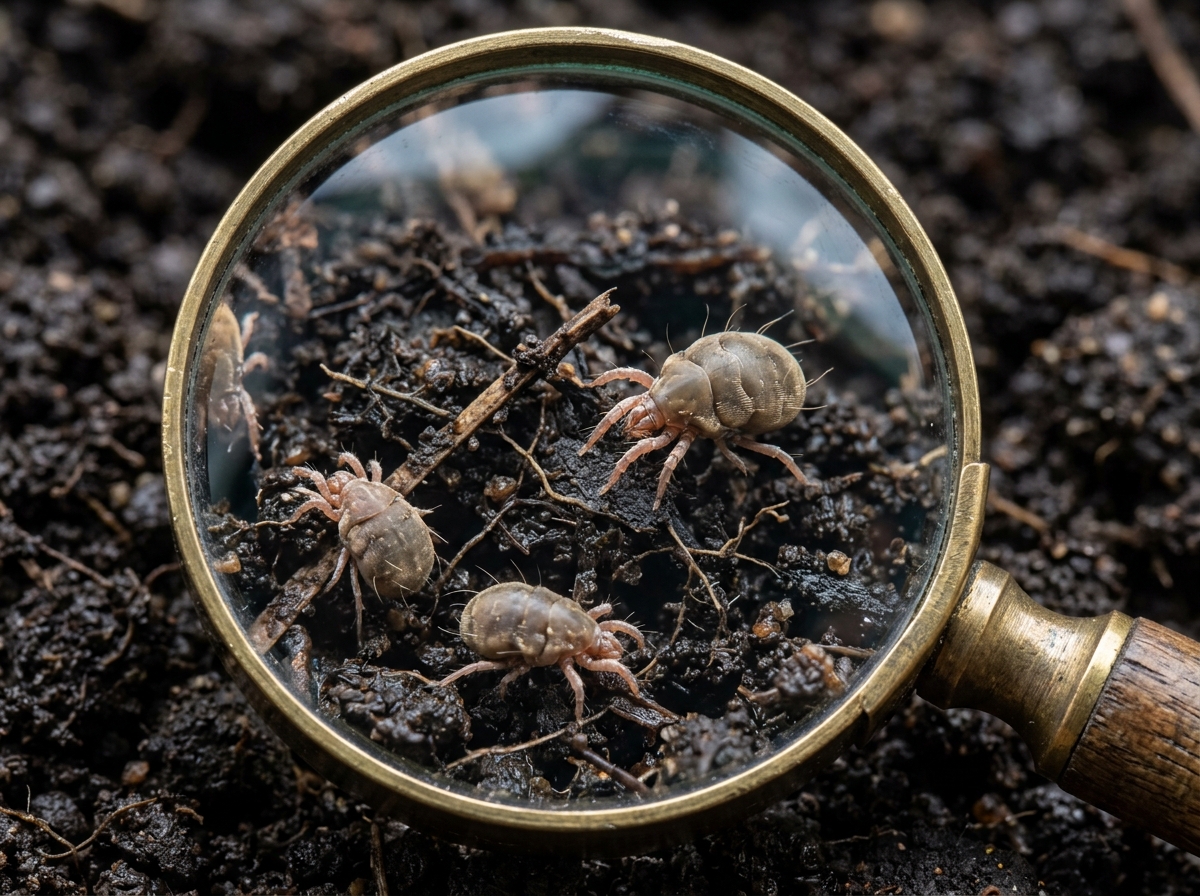
To understand soil mites, we first have to realize they aren’t insects. They are members of the subclass Acari, making them arachnids—distant cousins to spiders and scorpions. While we often group all tiny crawlies into the “bug” category, these microarthropods have a very specific biology that dictates how they live and what they eat.
Scientifically, these creatures are divided into two main body segments: the gnathosoma (the front part bearing the mouthparts) and the idiosoma (the main rounded body that carries their four pairs of legs). Most species you’ll find in your garden or indoor pots range from a microscopic 0.2mm to about 2mm in size. For more technical details on their classification, you can explore this Soil Mite – an overview | ScienceDirect Topics.
Identifying Soil Mites in Your Potting Mix
If you see something moving in your soil, don’t panic. Grab a 10x magnifying lens or use the macro setting on your smartphone camera. Here is what you are looking for:
- Appearance: Most common soil mites look like tiny white dots or small, round, shiny brown seeds. Some have a “hard-shelled” or armored appearance, which are often Oribatid mites.
- Movement: Unlike many slow-moving pests, some predatory soil mites move quite fast, scurrying across the surface when disturbed by light or water.
- Location: They stay almost exclusively in the soil or on the rim of the pot. If you see webbing on the leaves, you aren’t looking at soil mites—you likely have spider mites.
For a deeper dive into the specific families of these creatures, researchers often refer to the Soil Mites (Acari: Oribatida and Others) for taxonomic identification.
Common Causes of Mite Appearances
Why are they in your house? Usually, we invite them in without knowing it. Common triggers include:
- Overwatering: High moisture levels create the damp environment these arachnids crave.
- Organic Matter: If you use a lot of compost or organic fertilizers, you’re providing a buffet for decomposers.
- Unsterilized Soil: Many bagged soils, especially those containing real compost or aged forest products, naturally contain mite eggs.
- High Humidity: Areas with poor airflow and high moisture (like seed starting trays) are prime real estate for a population boom.
The Ecological Role of Soil Mites in Your Garden
In the grand scheme of nature, soil mites are the “janitors” of the earth. They are essential for nutrient cycling, helping to turn dead leaves and old roots into usable minerals for your plants. Without them, the process of humus formation—the creation of rich, dark organic soil—would be much slower.
They also act as bioindicators. A healthy, diverse population of mites usually means your soil is thriving and chemically balanced. When we choose the best-soil-for-indoor-plants, we are essentially creating a mini-ecosystem where these mites can do their best work. To understand more about how these groups respond to land management, see this study on Biomass and Diversity of Soil Mite Functional Groups.
Promoting Beneficial Soil Mites for Plant Health
Believe it or not, some gardeners actually want more mites. Beneficial species perform “ecosystem services” that are hard to replicate with chemicals:
- Fungal Dispersal: They carry mycorrhizal spores on their bodies, spreading beneficial fungi that help plant roots absorb water.
- Bacterial Transport: As they crawl, they move decomposer bacteria to new areas of the pot.
- Calcium Cycling: Oribatid mites are known to play a disproportionately large role in cycling calcium back into the soil.
- Pest Control: Predatory species like Mesostigmata hunt down fungus gnat larvae and thrips pupae.
You can learn more about these “tiny titans” at What is a Soil Mite? – The Institute for Environmental Research and Education.
Soil Mite Population Statistics
The sheer numbers are staggering. We aren’t just talking about a few dozen bugs; we’re talking about an entire civilization under your fingernails.
- Density: In a healthy forest, there can be 50,000 to 250,000 mites per square meter.
- Diversity: A single 100-gram soil sample can contain 500 mites representing nearly 100 different genera.
- Species Count: About 20,000 species have been described, but scientists estimate there may be over 80,000 in existence.
- Depth: While most stay in the top 5cm, some species have been found up to 10 meters deep in the earth!
Are They Harmful? Assessing the Risk to Plants and Humans
For the vast majority of indoor gardeners, soil mites are completely harmless. Most are detritivores, meaning they only eat dead things. They aren’t interested in your living plant tissue, your pets, or you.
Impact on Humans and Pets
We can breathe a sigh of relief: soil mites do not bite humans or pets. They are not parasitic. While some people confuse them with chiggers (which are the larval stage of a specific type of outdoor mite), those species are rarely found in indoor potting mixes.
In very specific agricultural settings outdoors, some Oribatid mites can act as intermediate hosts for tapeworms that affect grazing animals like horses, but this is a non-issue for your living room pothos. Indoors, they are 100% safe.
When Soil Mites Become a Problem
There are rare exceptions where mites can become “foes.”
- Bulb Mites: Certain species (like those in the Acaridae family) can attack flower bulbs, garlic, or onions, especially if the bulb is already bruised or rotting.
- Root-Feeding Species: In massive overpopulations, or if their preferred food (fungi) runs out, some mites might nibble on very tender seedling roots.
- Secondary Infections: If a plant already has root rot from overwatering, the mites will flock to the decaying tissue, which can sometimes speed up the plant’s decline.
Soil Mites vs. Spider Mites and Other Common Pests
One of the biggest issues for gardeners is misidentification. We often see a “tiny bug” and assume the worst. Use this table to tell the difference:
| Feature | Soil Mite | Spider Mite | Fungus Gnat | Springtail |
|---|---|---|---|---|
| Location | Soil surface | Leaves/Stems | Flying near soil | Soil surface |
| Webbing | None | Yes (fine silk) | None | None |
| Damage | None (usually) | Yellow stippling | Larvae eat roots | Minimal |
| Movement | Fast crawl | Slow crawl | Flying/Erratic | Jumps/Hops |
Distinguishing Soil Mites from Spider Mites
This is the most critical distinction. Spider mites live on the foliage, sucking the life out of leaves and leaving behind tell-tale webbing. Soil mites stay in the dirt. If your plant’s leaves look lush and green but you see bugs in the soil, you likely have the “good guys.” If you see tiny dots on the underside of leaves and the plant looks sickly, you have a spider mite infestation that requires immediate treatment.
Mites vs. Fungus Gnats and Springtails
If you see tiny white things jumping, those are springtails, not mites. Springtails are also beneficial decomposers and usually indicate high moisture.
If you see “worms” in the soil, you might have fungus gnat larvae. A great trick is the potato-slice method: place a raw potato slice on the soil surface for 4-8 hours. Lift it up, and if you see translucent larvae with black heads, you have fungus gnats. If you just see tiny round arachnids scurrying away, those are your friendly soil mites. Proper moisture management and repotting-indoor-air-purifying-plants can help resolve gnat issues without harming your mite population.
How to Manage and Prevent Soil Mite Populations Naturally
If the “ick factor” is just too high and you want to reduce the population, you don’t need harsh chemicals. We recommend a “cultural” approach—changing the environment so the mites decide to move on (or stop reproducing so fast).
- Surface Dry-Back: Allow the top 1-2 inches of soil to dry out completely between waterings. Mites need moisture to survive and move.
- Improve Airflow: Use a small fan to keep air moving. This dries the soil surface and makes the environment less hospitable for mites and fungus gnats.
- Horticultural Sand: Adding a half-inch layer of sand to the top of your pots can act as a physical barrier.
- Fertilizer Check: Over-fertilizing with organic “meals” (like bone or blood meal) provides an explosion of food for mites. Follow an indoor-plant-fertilizing-guide to ensure you aren’t over-feeding the soil.
Natural Eradication and Control Methods
If you truly have an infestation that is bothering you, try these steps:
- Neem Oil Drench: Mix 1-2 tablespoons of pure neem oil with a quart of water and a drop of dish soap. Use this to water the plant once a week for three weeks.
- Diatomaceous Earth (DE): Sprinkle food-grade DE on the dry surface of the soil. It acts like tiny shards of glass to the mites’ exoskeletons. Note: it only works when dry!
- Predatory Mites: You can actually buy “good” mites like Stratiolaelaps scimitus to eat the “bad” mites and gnat larvae. This is the ultimate organic “set it and forget it” method.
- Solarization: For outdoor garden beds, covering soil with clear plastic in the summer heat can “cook” excess mite populations.
Risks of Drastic Measures
We often see advice to “bake your soil” in the oven at 350°F to sterilize it. We strongly advise against this. Sterilizing soil kills everything—the beneficial bacteria, the helpful fungi, and the mites. This leaves your plant vulnerable because the first “bad” spore that lands in that sterile dirt will have no competition and will take over instantly. It also smells terrible! Stick to natural, gradual balance rather than total eradication.
Frequently Asked Questions about Soil Mites
Can bagged potting soil have bugs?
Yes, absolutely. Even high-quality store-bought mixes can contain soil mites or their eggs. This is especially true for organic mixes that contain compost or worm castings. If you want to avoid this, look for “soilless” mixes like coco coir or peat-based mixes that have been heat-treated, though even these can be colonized once they reach your home.
Do soil mites bite humans?
No. Their mouthparts are designed for grinding up tiny bits of fungus or leaf litter, not piercing human skin. Any “itching” felt after gardening is more likely a reaction to fertilizer, dry soil, or perhaps a stray outdoor chigger—but the mites living in your indoor pots are not the culprits.
Should I get rid of all soil mites?
In our expert opinion: No. Trying to achieve “zero bugs” in soil is a losing battle and usually results in less healthy plants. A few mites are a sign of a working ecosystem. Only act if the population is so high that they are crawling onto your furniture or if the plant is showing clear signs of distress.
Conclusion
At FinanceBillX, we believe that understanding the “tiny titans” in our soil is the first step toward becoming a better gardener. Soil mites aren’t a sign of a “dirty” home; they are a sign of a living, breathing piece of nature inside your four walls.
By maintaining a balance—not overwatering, providing good airflow, and using quality potting media—you can coexist with these beneficial arachnids. They’ll keep your soil healthy, and in return, your plants will thrive.
Want to dive deeper into keeping your indoor jungle happy? Learn more about plant care tips on our blog!
