
Your Orchid Is Asking for More Humidity — Here’s the Fix
A pebble tray for orchids is one of the simplest, cheapest ways to boost humidity around your plant without risking root rot. Here’s the quick version of how to set one up:
- Choose a shallow, watertight tray at least 1 inch wider than your orchid’s pot
- Fill it with pebbles or river stones in an even layer
- Add water until it sits just below the top of the pebbles
- Place your orchid pot on top so the roots never touch the water
- Refill as needed — more often in summer or dry, air-conditioned rooms
That’s it. The water evaporates upward, wrapping your orchid in a pocket of moist air that mimics its natural tropical habitat.
If you’ve noticed browning leaf tips, crispy edges, or leaves that look a little sad and droopy, your orchid is almost certainly struggling with dry indoor air. Orchids are epiphytic plants — in the wild, they cling to tree bark and soak up moisture directly from the humid air around them through their leaves and roots.
Most apartments, especially with heating or air conditioning running, sit well below the humidity levels orchids actually need. A pebble tray won’t solve everything, but research shows it can raise the relative humidity in the immediate area by around 8 percentage points — and when you group several plants together on a larger tray, that number can climb much higher.
It costs about $5 and 15 minutes to set up. And it works.
Why Orchids Crave Extra Humidity
If your orchid could talk, it would probably complain about how dry your living room is. Most common indoor orchids, like the Phalaenopsis or Dendrobium, are tropical natives. They are epiphytic, meaning in nature they don’t grow in soil but cling to tree branches. Their roots are exposed to the air, designed to grab moisture directly from the humid jungle atmosphere.
When we bring them indoors, our modern climate control systems (HVAC) strip the moisture from the air. This leads to several visible signs of distress:
- Browning leaf tips and edges: The most common sign that the air is too parched.
- Crispy or “paper” edges: New growth might look torn or misshapen because it can’t unfurl properly in dry air.
- Wilted or curled foliage: Even if the medium is damp, the plant loses water through its leaves faster than it can take it up.
Orchids utilize a process called foliar absorption. This means they don’t just “drink” through their roots; they soak up ambient moisture through their leaves. Providing a consistent source of air moisture is just as important as your indoor-plant-sunlight-requirements. Without it, the plant enters a state of stress, leading to fewer blooms and a shorter lifespan. For a deeper dive into atmospheric needs, check out our indoor-plant-humidity-guide.
How a Pebble Tray for Orchids Works
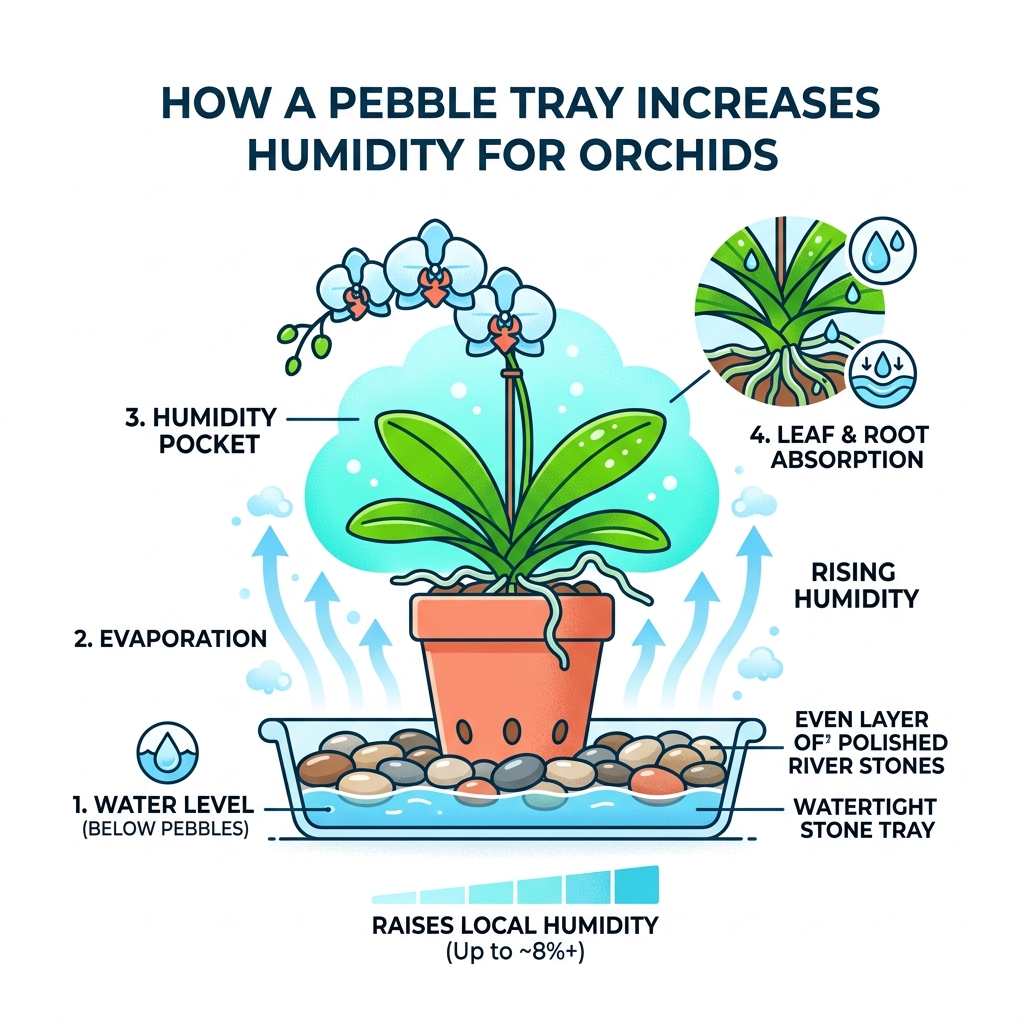
The science behind a pebble tray for orchids is beautifully simple: evaporation. As the water in the tray sits exposed to the air, it slowly turns into water vapor. Because the orchid is sitting directly above this water source, it lives within a “microclimate” of higher humidity.
Does it actually work? Data suggests it does, though the effects are localized. In a room kept at 21-23°C (70-73°F), a standard pebble tray has been shown to increase relative humidity (RH) from a baseline of 45% to about 53%—a solid 8% jump. Interestingly, the humidity directly at the surface of the pebbles can be as high as 78%, while the air 6 inches above the tray sits around 66%.
This is why a pebble tray for orchids is so effective; it targets the “breathing” zone of the plant. Whether you use a DIY setup or specialized humidity trays, the goal is to keep the pot elevated. You want the benefits of the vapor without the danger of “wet feet.” Many enthusiasts even use decorative ORCHIDEA slate matt planters that have built-in reservoirs to achieve a similar effect with a sleeker look.
Comparing Humidity Methods for Tropical Plants
We often get asked: “Can’t I just mist my plants?” While misting feels productive, it’s often the least effective method for long-term orchid health. Let’s look at the numbers.
| Method | Humidity Boost | Duration | Pros/Cons |
|---|---|---|---|
| Pebble Tray | 5-10% | Constant | Low cost, low maintenance, localized. |
| Plant Mister | Temporary spike | 5-10 mins | Can cause fungal issues if water sits on leaves. |
| Humidifier | 20-40%+ | As long as it’s on | Best for large rooms; requires electricity/cleaning. |
| Plant Grouping | Up to 25% | Constant | Creates a “humidity island” via collective transpiration. |
Grouping your plants on a large pebble tray for orchids is the “gold standard” for DIY care. When plants are huddled together, they trap the moisture they release through their leaves, creating a pocket of air that can be significantly more humid than the rest of the house. For more ways to optimize your setup, see our indoor-plant-growth-tips and general tips-for-healthy-houseplants.
Step-by-Step Setup and Maintenance
Setting up your tray takes less time than making a cup of coffee. However, doing it wrong can lead to the one thing orchids hate more than dry air: root rot.
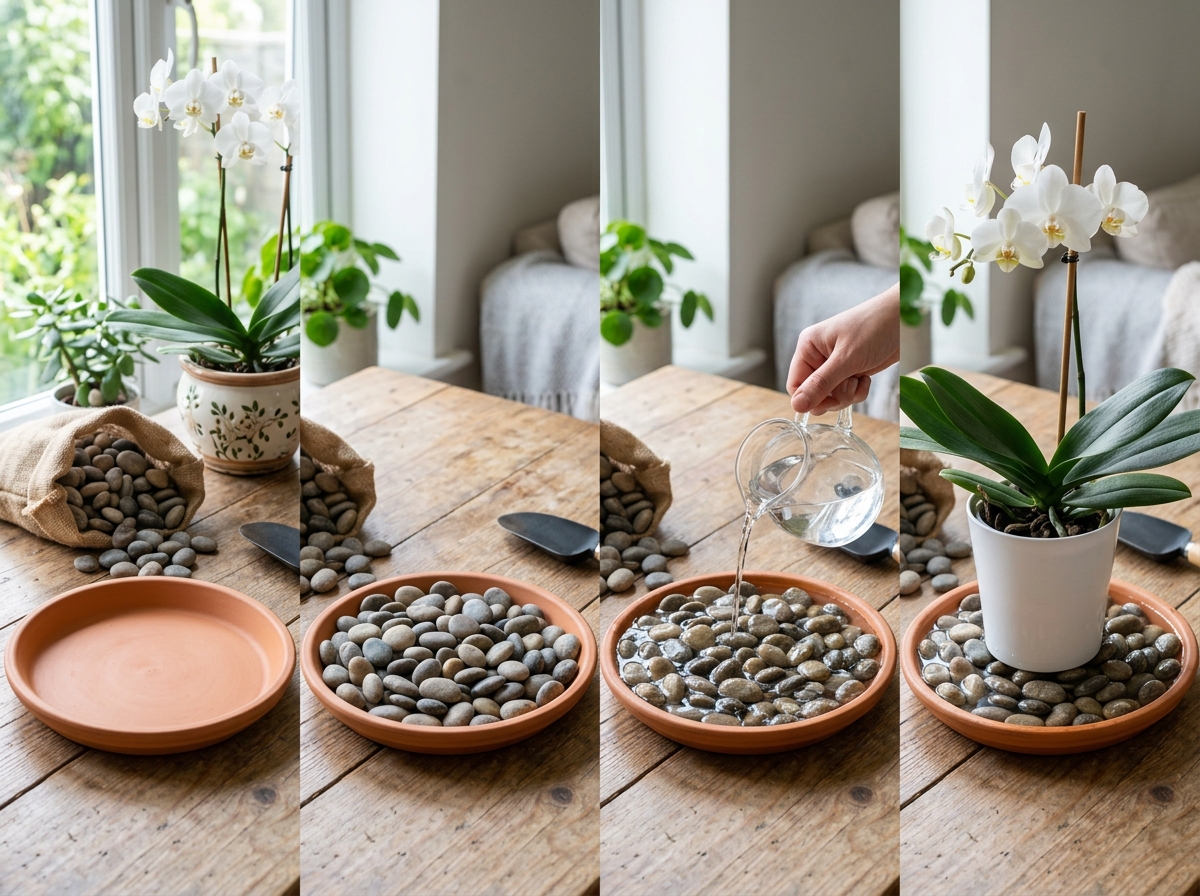
The DIY Process:
- The Tray: Find a water-tight saucer or tray. It should be at least 1-2 inches wider than the base of your pot.
- The Fill: Add an even layer of pebbles. River stones, clay pebbles (LECA), or even decorative glass beads work perfectly.
- The Water: Pour in water until it is just below the top of the stones. Crucial rule: The bottom of the orchid pot must stay dry. If the pot sits in water, the orchid will suck up too much moisture, leading to indoor-plant-watering-mistakes like mushy roots.
- The Placement: Set your orchid on top. The pebbles act as a pedestal.
Maintenance and Hygiene
Because you have standing water, you need to keep things clean to avoid indoor-plant-pest-control-naturally issues like fungus gnats or algae.
- Refill: Check the water level weekly. In summer heat or dry AC, it may evaporate faster.
- Deep Clean: Once a month, remove the stones and wash the tray. A quick vinegar soak helps remove hard water mineral buildup.
- Pro Tip: Some growers add a few pieces of activated charcoal to the water to keep it fresh and prevent that “stagnant water” smell.
Choosing the Right Pebble Tray for Orchids
While any tray works, some are better than others. ABS plastic trays are popular because they are sturdy and waterproof. If you have a single, prized plant, a Round Humidity Tray offers a stylish, organic look. For those who want something more decorative, a Small Multi Orchid Print Tray can add a touch of botanical art to your display.
If you have a large collection, look for specialized trays with drainage grates. These allow you to water the orchid right where it sits; the runoff falls into the tray and becomes the next batch of humidity!
DIY Pebble Tray for Orchids Materials
You don’t need a degree in botany to gather these supplies. Most are available at your local garden center or even in your kitchen:
- Trays: Boot trays, baking sheets (if rust-proof), or dedicated 3D printed humidity trays.
- Pebbles: 3/8″ river stones are the standard. Clay pebbles (LECA) are excellent because they are porous and have more surface area for evaporation.
- Water: Distilled or rainwater is best if you want to avoid white mineral crusts, but tap water works fine if you clean the tray regularly.
Frequently Asked Questions
Do pebble trays actually increase humidity effectively?
Yes, but don’t expect a tropical rainforest in a drafty room. As mentioned, you can expect about an 8% increase in relative humidity. While this sounds small, for an orchid struggling at 40% RH, moving to 48% can be the difference between a blooming plant and a dying one. To be sure, we recommend using a small digital hygrometer placed at foliage level to see the difference for yourself.
How often should I refill the water in the tray?
This depends entirely on your home’s environment. During summer heat waves or peak winter heating, you might need to refill every 2-3 days. In more temperate conditions, once a week is usually sufficient. Always keep the water level just below the pebble line.
Can I use one tray for multiple orchids?
Absolutely! In fact, it’s better. Using a large “community tray”—like a 26-inch Quad Grate Humidi-Grow Tray—allows you to group plants together. This creates a larger “humidity island” that is much more stable than a single small tray.
Conclusion
At FinanceBillX, we believe that plant care shouldn’t be a chore or an expensive mystery. Using a pebble tray for orchids is a low-tech, high-reward solution that pays off in vibrant blooms and lush, green leaves. By mimicking the natural evaporation of the tropics, you give your orchids the atmospheric support they need to thrive indoors.
Ready to take your indoor jungle to the next level? Explore more expert orchid care tips to keep your collection healthy and beautiful all year round!
