
The Myth That Won’t Die: House Plants Don’t Purify Air (And Science Proves It)
House plants don’t purify air in any meaningful way — and decades of scientific research back that up.
Here’s the quick answer:
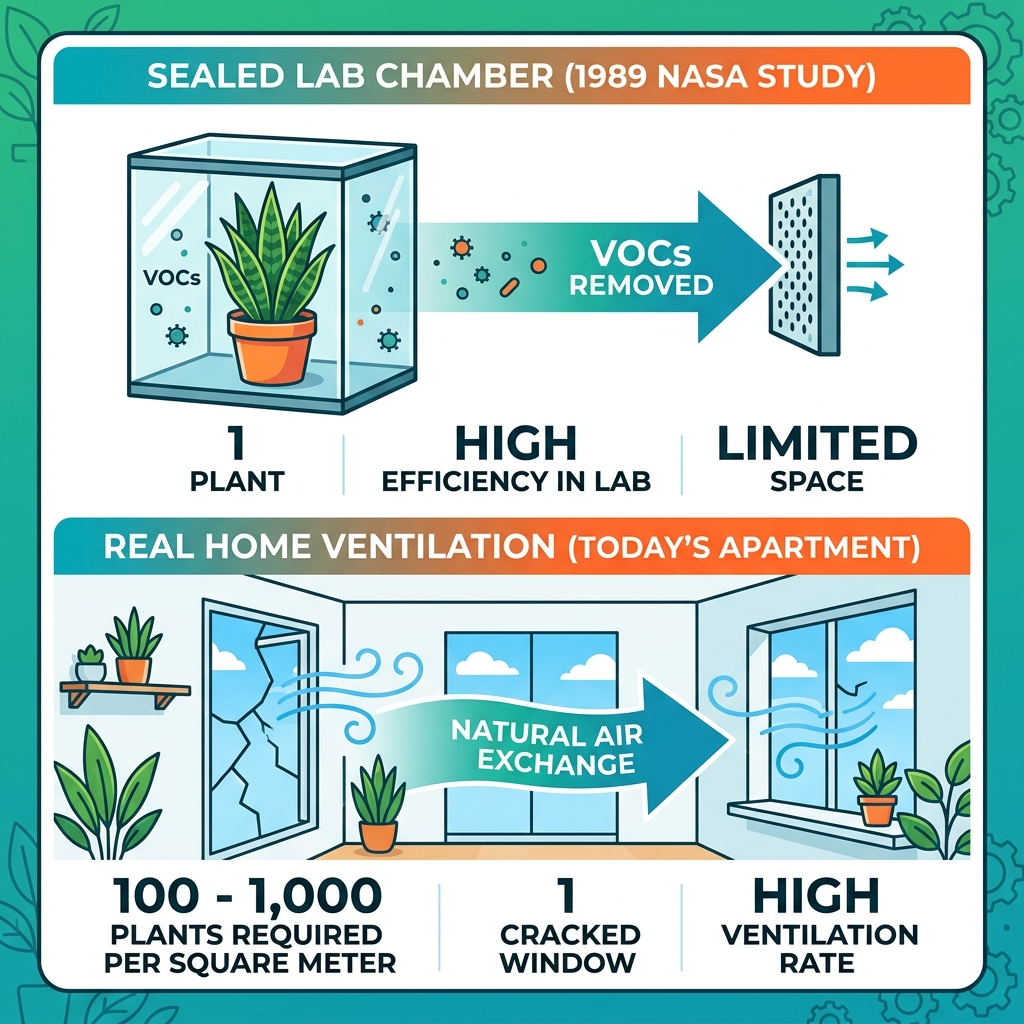
- The origin: A 1989 NASA study tested plants in sealed chambers — nothing like your apartment
- The reality: Natural ventilation removes VOCs far faster than any houseplant can
- The numbers: You’d need 100–1,000 plants per square meter to match a cracked-open window
- The verdict: Plants offer real benefits, but clean air isn’t one of them
If you’ve ever arranged a row of snake plants on your windowsill or splurged on a peace lily because you read it “removes toxins,” you’re not alone. The idea that houseplants scrub your indoor air has been repeated so many times — by wellness blogs, interior design magazines, and plant sellers — that it feels like established fact.
It isn’t.
The myth traces back to a single NASA experiment from 1989. Researchers were trying to figure out how to clean air inside space stations — sealed, airless environments with no windows. The results got picked up by media, stripped of context, and turned into a universal recommendation for your living room.
The problem? Your apartment is nothing like a space station.
Modern scientific reviews — including a major 2019 analysis by researchers at Drexel University — have re-examined 30 years of plant air-purification studies. Their conclusion is clear: in a real home or office, houseplants remove volatile organic compounds (VOCs) at a rate orders of magnitude slower than normal air exchange does.
The gap between the lab and your living room is enormous. And understanding it could save you money, frustration, and a lot of misplaced hope.
The NASA Myth: Why House Plants Don’t Purify Air in Real Homes
To understand why we all believe this “leafy legend,” we have to go back to 1989. NASA scientist Bill Wolverton published a seminal study aimed at solving a very specific problem: how to keep the air breathable for astronauts on space stations. These stations are essentially airtight tin cans floating in a vacuum. In that hyper-controlled environment, Wolverton found that certain plants could indeed absorb Volatile Organic Compounds (VOCs) like formaldehyde and benzene.
However, the media took these findings and ran with them, ignoring the most critical detail: the “sealed chamber.” In these experiments, a single plant was placed inside a small, airtight plastic box. Researchers injected a high concentration of a single toxin and tracked its decay over several days.
As noted in Which houseplants should you buy to purify air? None of them. | National Geographic, these conditions bear zero resemblance to a modern home. Our houses “breathe.” Even with the windows shut, air leaks in through doors, vents, and cracks in the floorboards. This natural air exchange happens constantly, diluting indoor pollutants far faster than a Pothos ever could.
We’ve previously explored the-science-behind-plants-improving-indoor-air-quality, but the consensus among environmental engineers today is that the original NASA results were never meant to be applied to a drafty suburban home or a ventilated office building. In a space station, every molecule counts; in your living room, the “air cleaning” done by a plant is statistically invisible.
The Numbers Game: 5,000 Plants for a Studio Apartment
If you truly wanted to replicate the air-purifying effects seen in those famous lab studies, you would need to turn your home into an impenetrable thicket. Michael Waring, an associate professor of environmental engineering at Drexel University, conducted a massive meta-analysis of 30 years of research to settle this debate once and for all.
Waring used a metric called the Clean Air Delivery Rate (CADR). This is the same standard used to measure the effectiveness of mechanical air purifiers. What he found was startling: the CADR of a typical houseplant is orders of magnitude lower than the ventilation already occurring in your home.

According to the Study: Actually, potted plants don’t improve indoor air quality | EurekAlert!, the natural air exchange in a building—even a relatively “tight” energy-efficient one—is simply too powerful for plants to compete with. To actually see a measurable reduction in VOCs that could impact your health, you would need a plant density that is physically impossible for most people to maintain.
| Method of Air Cleaning | Relative Effectiveness | Plants Required (per sq. meter) |
|---|---|---|
| One Open Window | High | 0 |
| HVAC System | High | 0 |
| 1-2 Houseplants | Negligible | N/A |
| To Match Ventilation | – | 100 – 1,000 |
Why House Plants Don’t Purify Air According to Modern Science
The math is quite humbling. To achieve the VOC reduction reported in lab settings, you would need between 10 and 1,000 plants per square meter of floor space. Let’s put that into perspective:
- For a 500-square-foot studio apartment: You would need roughly 5,000 plants. You wouldn’t be able to see your furniture, let alone walk to the kitchen.
- For a 1,500-square-foot home: You would need about 680 large, healthy plants just to remove a significant portion of the chemicals found in everyday household items.
The reality is that house plants don’t purify air because they are simply too slow. While we’ve discussed reducing-indoor-toxins-with-the-right-plants in the past, it’s important to clarify that “reducing” doesn’t mean “eliminating” or even “meaningfully impacting” the air quality in a standard domestic environment. A single cracked window for ten minutes provides more fresh air than a forest of indoor palms could provide in a week.
Hidden Risks: Mold, Pests, and Allergens
While the air-purification benefits are a myth, the potential downsides of keeping an indoor jungle are very real. When we fill our homes with dozens of pots of damp soil, we aren’t just bringing in greenery; we are creating a micro-ecosystem that can sometimes work against our health.
The most common issue is overwatering. Many enthusiasts, in an attempt to keep their “air purifiers” thriving, keep the soil too wet. This leads to the growth of mold and fungi in the potting mix. Spores from these molds can become airborne, potentially triggering respiratory issues or allergic reactions in sensitive individuals.
Furthermore, large-leafed plants like Monsteras or Fiddle Leaf Figs are notorious dust magnets. Unless you are meticulously wiping down every leaf once a week, they serve as a landing pad for household dust and pet dander. Instead of cleaning the air, they effectively store allergens right at eye level. This is why repotting-indoor-air-purifying-plants properly and maintaining cleanliness is vital for more than just the plant’s health.
When House Plants Don’t Purify Air and Instead Attract Pests
Beyond mold, plants can introduce a variety of uninvited guests into your sanctuary. Fungus gnats thrive in moist indoor soil, and while they are mostly a nuisance, spider mites and mealybugs can quickly infest an entire collection.
The American Lung Association and other experts noted in Think Houseplants Purify the Air? Science Says Otherwise that for some people, the presence of certain plants can actually decrease indoor air quality. Flowering plants can release pollen, and the humidity generated by a high volume of plants can encourage dust mites. If you have asthma or severe allergies, a “plant-filled oasis” might actually be making your symptoms worse.
Real Solutions for Cleaner Indoor Air
If you’re concerned about VOCs from your new carpet, the “new car smell” of your furniture, or the lingering scent of cleaning products, don’t head to the nursery. There are far more effective, science-backed ways to improve the air you breathe.
- Source Control: This is the most effective method. If a product smells strongly of chemicals, it’s likely off-gassing VOCs. Switch to low-VOC paints, fragrance-free cleaning supplies, and natural fiber furnishings when possible.
- Ventilation: As the Air-Purifying Plants are a Myth | Apartment Therapy article points out, nothing beats fresh air. Opening your windows for just 15 minutes a day can drastically reduce the concentration of indoor pollutants.
- Mechanical Filtration: If you live in a polluted city or have allergies, invest in a high-quality HEPA (High-Efficiency Particulate Air) filter. A portable HEPA air cleaner can remove 99.97% of dust, pollen, and smoke particles.
- Upgrade Your HVAC: Ensure you are changing your furnace filters every 2-3 months. If your system allows it, upgrading to a MERV 13 filter can provide a significant boost in capturing fine particles that plants simply cannot touch.
Why We Still Love Our Green Roommates
By now, you might be thinking about rehoming your Pothos. Don’t! Just because house plants don’t purify air doesn’t mean they aren’t worth having. The benefits of houseplants are primarily psychological and aesthetic, and those benefits are profound.
The concept of biophilia suggests that humans have an innate tendency to seek connections with nature. Having plants in your workspace has been shown to reduce stress, lower blood pressure, and increase productivity. There is a genuine joy in watching a new leaf unfurl or successfully reviving a struggling fern.
Plants also act as natural humidifiers. Through a process called transpiration, they release moisture into the air. In the dry winter months or in air-conditioned offices, this can help prevent dry skin and irritated sinuses. While we’ve discussed how peace-lilies-and-their-contribution-to-better-air-quality is often overstated in terms of toxin removal, their ability to brighten a room and boost your mood is undisputed. They make our homes feel like “home.”
Frequently Asked Questions about Air Purifying Plants
How many plants do I need to clean the air?
To see any measurable difference that competes with your home’s natural ventilation, you would need about 10 plants per square foot. For most people, this is an impractical and expensive density that would make a home nearly unlivable. It is much more effective to rely on an air purifier or an open window.
Did NASA lie about their plant study?
No, NASA didn’t lie; the study was scientifically sound for its intended purpose. The researchers were looking at closed ecological life-support systems for space travel. The “lie” (or rather, the misconception) was created by marketers and media outlets who stripped the study of its “sealed chamber” context and applied the results to open, ventilated buildings where they don’t apply.
What is the best way to remove VOCs?
The best way is to remove the source of the VOCs first. If that isn’t possible, increasing ventilation (opening windows) or using an air purifier with a thick activated carbon filter is the most effective strategy. Standard HEPA filters are great for dust and pollen, but you specifically need carbon to “soak up” gaseous VOCs.
Conclusion
The scientific consensus is in, and it’s time to retire the “air-purifying” marketing tag. While it’s a myth we almost wish hadn’t been busted, knowing the truth allows us to make better decisions for our health and our homes. We should buy plants because they are beautiful, because they make us happy, and because they connect us to the natural world—not because we expect them to do the job of a mechanical air filter.
At FinanceBillX, we believe in making informed choices based on data, not trends. Whether you are designing a home office or looking for ways to improve your well-being, start with realistic expectations. Keep your plants for your soul, but get an air purifier for your lungs.
For more insights on creating a healthy, efficient living space, check out our More info about indoor environment services.
