
The Best Plants for Offices: Your Quick-Start Guide
The best plants for offices are low-maintenance, low-light champions that survive missed waterings, dry air, and fluorescent bulbs — no green thumb required.
Top office plants at a glance:
| Plant | Light Needed | Watering Frequency | Best For |
|---|---|---|---|
| Snake Plant | Low to medium | Every 3-4 weeks | Desks, corners, reception |
| ZZ Plant | Low | Every 3-4 weeks | Windowless offices |
| Pothos | Low to medium | Every 1-2 weeks | Shelves, trailing displays |
| Peace Lily | Low to medium | When leaves droop | Shared spaces |
| Spider Plant | Medium | When top 2 inches dry | Desks, hanging baskets |
| Parlor Palm | Medium | Weekly | Lobbies, conference rooms |
| Cast Iron Plant | Very low | When fully dry | No-window zones |
| Chinese Evergreen | Low to medium | When top inch dry | Corners, side tables |
| Peperomia | Low to medium | When completely dry | Small desks |
| Air Plants | Indirect light | Soak weekly | Minimal-space desks |
You probably spend more time at the office than you’d like to admit. And if that office feels a little flat — harsh lighting, recycled air, gray everything — you’re not imagining it.
There’s a real cost to that environment.
Research, including a well-known UK study, found that workers with indoor plants nearby were 15% more productive than those without. That’s not a small number. That’s the difference between a slow Tuesday and a genuinely good workday.
But here’s the catch: less than 1% of all known plant species can actually handle the typical office environment. Low light, dry air from HVAC systems, irregular watering — most plants simply don’t survive it.
The good news? The ones that do thrive in offices are easy to find, affordable, and nearly impossible to kill — even if your track record with plants is, let’s say, complicated.
This guide cuts through the noise and shows you exactly which plants work, where to put them, and how to keep them alive without turning plant care into a second job.

Why Your Workspace Needs a Green Upgrade
We often think of office plants as mere decoration, but they are actually functional pieces of office equipment. Think of them as silent, solar-powered air scrubbers. Modern offices are filled with synthetic furniture, carpets, and printers that off-gas Volatile Organic Compounds (VOCs) like benzene, trichloroethylene, and formaldehyde.
According to NASA’s famous Clean Air Study, certain plants are incredibly efficient at filtering these toxins. For instance, the Spider Plant is a champion at removing benzene, while the Peace Lily can reduce airborne mold counts by up to 56% in humidified spaces. Beyond the chemistry, there is the psychology. Integrating nature into our indoor environments—a concept known as biophilic design—is proven to lower cortisol (the stress hormone) and improve cognitive function.
When we see green leaves, our brains shift into a more relaxed, creative state. This isn’t just a “feeling”; it’s a measurable biological response. If you’re looking to dive deeper into the science, The ultimate guide to choosing and looking after indoor plants for offices / RHS offers a fantastic look at how these biological benefits translate to the professional world. At FinanceBillX, we believe that boosting productivity with the right indoor plants is one of the highest-ROI investments you can make in your workspace.
The Best Plants for Offices: From Desk Buddies to Floor Statements
Selecting the best plants for offices requires looking past the “Pinterest-perfect” aesthetics and focusing on physiological resilience. In a real office, plants deal with HVAC drafts, long weekends without water, and light levels that would make a sunflower weep. We want plants that store water in their leaves or roots and have slow growth rates so they don’t outgrow their pots every six months.
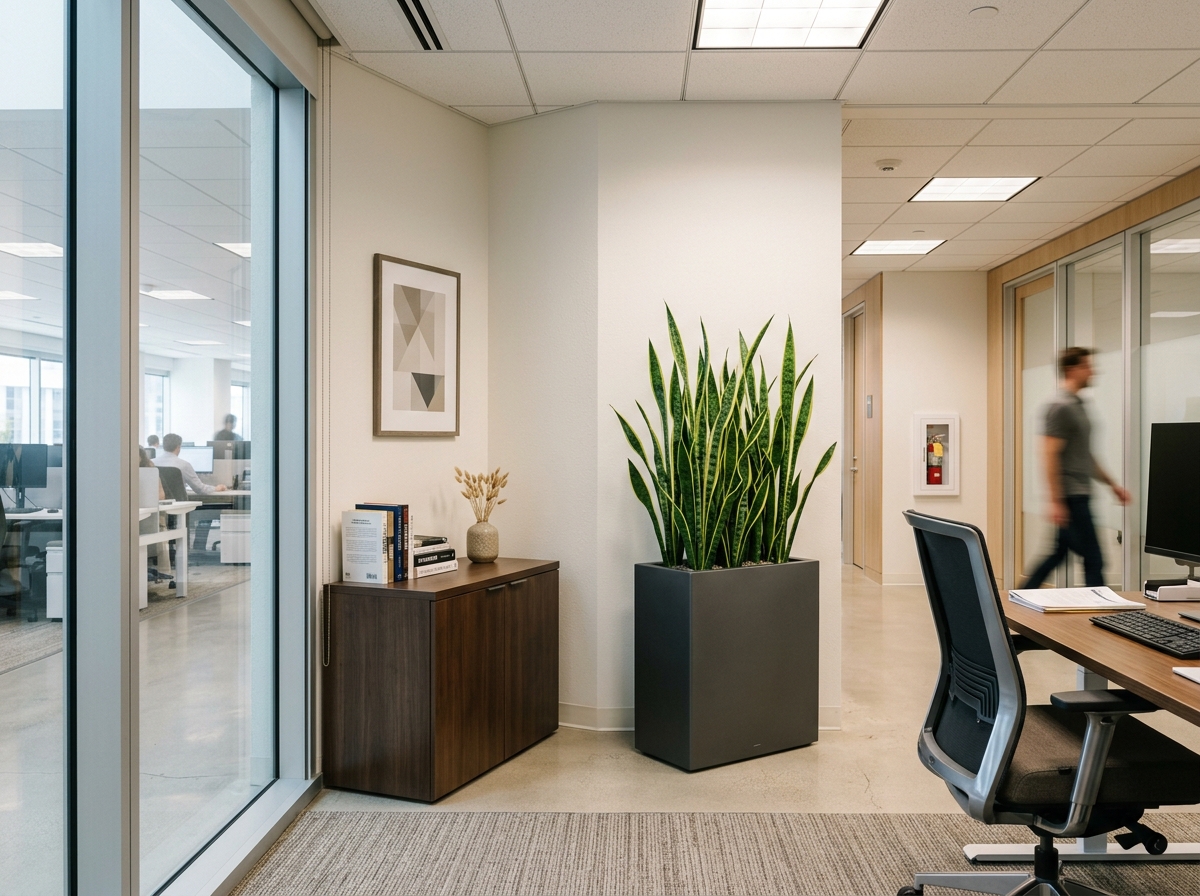
Best plants for offices with no windows
If your office is essentially a glorified bunker, don’t despair. You can still grow real greenery. The trick is to choose species that evolved on forest floors under heavy canopies, where they learned to survive on “biological scraps” of light. These plants have high chlorophyll density, allowing them to photosynthesize effectively under standard office fluorescent or LED lights.
- Snake Plant (Dracaena trifasciata): This is the undisputed king of windowless rooms. It uses a special type of photosynthesis (CAM) that allows it to absorb CO2 at night, and it can survive for weeks without a drop of water. It’s virtually unkillable.
- ZZ Plant (Zamioculcas zamiifolia): The ZZ plant features waxy, deep green leaves that look fake because they are so perfect. Its tuberous roots store water like a camel, making it the ultimate “set it and forget it” plant.
- Cast Iron Plant (Aspidistra elatior): As the name suggests, this plant is as tough as metal. It was a favorite in Victorian-era homes because it could survive the dim, smoky air of coal fires. In a modern windowless office, it thrives where others fail.
For those navigating the challenges of artificial light, 15 Best Office Plants | BBC Gardeners World Magazine provides excellent variety for these low-light scenarios. For a deeper dive into the technical specs of these survivors, check out What Are Good Office Plants: 12 Science-Backed Choices & Care Guide.
Best plants for offices on small desks
When real estate is limited to a corner of your desk, you need plants that stay compact or offer high visual impact without taking up your mousepad space.
- Pothos: Often called “Devil’s Ivy” because it’s so hard to kill, Pothos is a vining plant that can trail down the side of a filing cabinet or be pruned to stay bushy. Its heart-shaped leaves add a soft, organic touch to sharp office lines.
- Peperomia: These are fantastic because they come in dozens of varieties with different textures and colors, yet they rarely grow larger than 12 inches. They are sturdy, hold water in their leaves, and don’t mind the dry air of an air-conditioned office.
- Air Plants (Tillandsia): These are epiphytes, meaning they don’t need soil at all. You can set them in a decorative bowl or on a piece of driftwood. They just need a weekly soak in water to stay happy.
If you are looking for ways to maximize your workstation’s health benefits, we have a guide on making office desks better with air-purifying plants that covers these small-scale wonders in detail.
How to Keep Your Office Jungle Alive
The biggest mistake people make with office plants is “killing them with kindness”—usually in the form of too much water. In a low-light office, plants use water very slowly. If the soil stays wet for weeks, the roots will rot.
| Maintenance Task | Low-Light Plants (Snake, ZZ) | Bright-Light Plants (Succulents, Palms) |
|---|---|---|
| Watering | Every 3-4 weeks | Every 1-2 weeks |
| Light | Fluorescent/LED is fine | Needs a window or grow light |
| Fertilizer | Twice a year (Spring/Summer) | Monthly during growth |
| Cleaning | Wipe leaves monthly | Dust every 2 weeks |
The Finger Test: Before you reach for the watering can, stick your finger two inches into the soil. If it feels damp, walk away. If it’s bone-dry, give it a drink. Always ensure your pots have drainage holes; sitting in a pool of stagnant water is a death sentence for 80% of indoor plants.
Lighting and Dusting: While the best plants for offices can handle fluorescent light, they still need it for at least 8-10 hours a day. Also, keep in mind that office dust can reduce light penetration by up to 50%. A quick wipe with a damp microfiber cloth every few weeks keeps the “solar panels” of your plant working efficiently.
Pest Prevention: The most common office pests are fungus gnats (tiny flies) and mealybugs (white fuzzy spots). Gnats usually appear because the soil is too wet. If you see them, let the soil dry out completely. For other pests, a simple spray of diluted neem oil or a wipe with isopropyl alcohol usually does the trick. We’ve put together a comprehensive resource on arranging your plants in the office to help you design a layout that keeps maintenance simple and effective.
Strategic Placement and Safety Considerations
Where you put your plant matters just as much as how you water it. We like to think in terms of “microzones.”
- The Danger Zones: Avoid placing plants directly under HVAC vents or near drafty entryways. Rapid temperature shifts—even just 5 degrees—can cause sensitive plants like the Weeping Fig or Rubber Plant to drop their leaves in protest.
- The Statement Zones: For lobbies and large corners, go big. A Monstera deliciosa (Swiss Cheese Plant) or a Kentia Palm creates a high-end, professional look. These larger plants also act as natural sound buffers in open-plan offices.
- Safety First: If your office is pet-friendly or visited by children, toxicity is a factor. Plants like the Peace Lily, ZZ Plant, and Snake Plant are mildly toxic if ingested. For a 100% safe environment, stick to the Spider Plant, Parlor Palm, or Boston Fern, all of which are cleared by ASPCA guidelines.
For larger corporations, managing dozens of plants can be a hassle. This is where professional plant rental and maintenance services come in. They handle the watering, pruning, and even replace plants that aren’t looking their best. You can find more about creating a holistic workspace in The Ultimate Guide to Office Plants for a Healthier, Happier Workspace – The Balcony Garden US.
Frequently Asked Questions about Office Greenery
Can office plants survive in windowless rooms?
Yes! Many of the best plants for offices, such as the ZZ Plant and Snake Plant, are perfectly happy living under standard office fluorescent bulbs. These lights provide enough of the blue-spectrum light that plants need for foliage growth. Just ensure the lights are on for at least 8 to 10 hours during the workweek.
How often should I water my office plants?
There is no fixed schedule because every office has different humidity and light levels. Use the “finger test”: insert your finger 2 inches into the soil. For most office plants, you should only water when the top 2 inches are dry. In winter, when growth slows and the air is drier, you might find yourself watering even less frequently.
Do office plants attract pests?
They can, but it’s usually a sign of an underlying issue. Fungus gnats are the most common and are almost always a result of overwatering. By letting the soil dry out between waterings and keeping the leaves free of dust with a microfiber cloth, you can prevent most infestations before they start.
Conclusion
At FinanceBillX, we see office plants as more than just greenery—they are a biophilic investment in your team’s most valuable asset: their focus and well-being. Transitioning to a sustainable, vibrant workspace doesn’t require a degree in botany; it just requires choosing the right partners for your environment.
Whether you’re starting with a single succulent on your desk or a floor-to-ceiling green wall in the lobby, the benefits to your productivity and mood are undeniable. Ready to breathe new life into your workday? Transform your office environment today and see what a 15% productivity boost feels like in practice.
