
Your Houseplants Are Dying — And Hydrogen Peroxide Might Be the Fix
Hydrogen peroxide root rot treatment is one of the most effective, low-cost ways to rescue a struggling houseplant. Here’s the quick answer:
How to treat root rot with hydrogen peroxide:
- Mix 1 part 3% hydrogen peroxide with 4 parts water (0.6% final concentration)
- Remove the plant, trim all black or mushy roots with sterilized scissors
- Soak roots in the solution for 10–30 minutes
- Repot in fresh, well-draining soil
- Allow soil to dry slightly between waterings going forward
You water your plants. You give them light. You talk to them (no judgment). Then one day, leaves start yellowing, stems go limp, and no matter what you do, the plant keeps declining.
Sound familiar? The culprit is often root rot — and it’s more common in indoor plants than most people realize.
Root rot happens when roots sit in waterlogged, oxygen-starved soil. That environment is a welcome mat for fungal pathogens like Pythium, Phytophthora, and Fusarium. Once they take hold, roots turn brown, mushy, and start to smell. By the time you notice something is wrong above the soil, the damage below is already serious.
The good news? A simple bottle of 3% hydrogen peroxide — the same kind you can find at any pharmacy — can help stop the rot, kill the pathogens, and give your plant’s roots a fighting chance to recover.
But concentration and technique matter a lot. Too weak and it won’t work. Too strong and you’ll damage the very roots you’re trying to save, and potentially wipe out the beneficial microbes your soil depends on.
This guide walks you through exactly how to use hydrogen peroxide safely and effectively — whether you’re dealing with a wilting pothos, a struggling peace lily, or a hydroponic setup gone wrong.
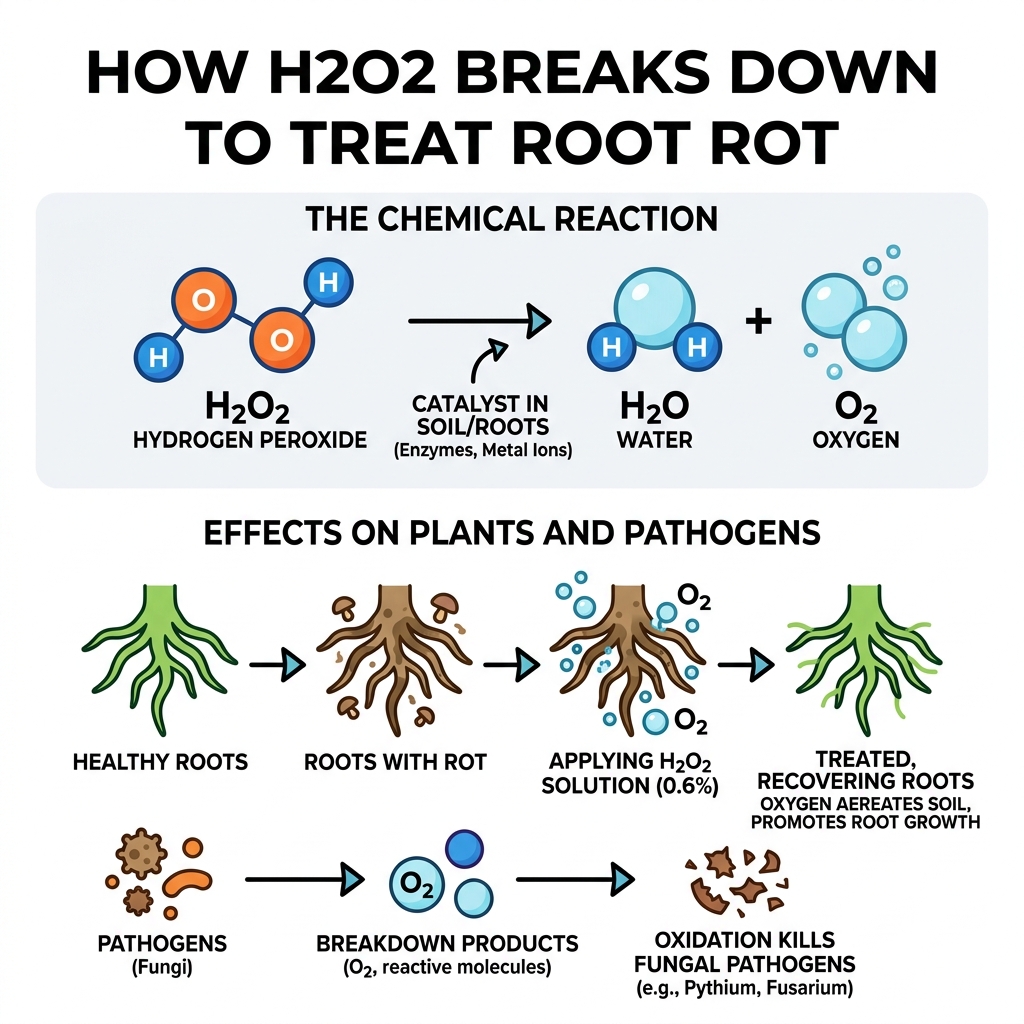
How to Treat Hydrogen Peroxide Root Rot: A Step-by-Step Guide
When we see our favorite green friends drooping, it’s tempting to just pour some “medicine” into the pot and hope for the best. However, treating hydrogen peroxide root rot effectively requires a bit of surgery. Think of it as a spa day, but with more scissors and a lot of bubbles.
Before you start, make sure you have 3% food-grade hydrogen peroxide. This is the standard strength found in most pharmacies. If you happen to have a stronger version (like 6% or the 30% greenhouse grade), you must adjust your math significantly to avoid turning your plant into a chemistry experiment gone wrong.
The Preparation Phase
First, we need to get the plant out of its soggy environment. Gently remove the plant from its pot and shake off as much old, contaminated soil as possible. You might need to rinse the roots under lukewarm tap water to see what you’re actually working with.

Now comes the “tough love” part. Using shears that you have sterilized with isopropyl alcohol, you need to perform some strategic pruning for your houseplants. Cut away any roots that are brown, black, slimy, or mushy. You want to cut back until you see firm, creamy-white tissue. If the root sloughs off in your hand like overcooked pasta, it’s got to go.
Choosing Your Dilution Ratio
There are two main schools of thought for the dilution ratio:
- 1:2 Dilution (Mild to Moderate): Mixing one part 3% H2O2 with two parts water. This is often used for soil drenches or quick rinses.
- 1:4 Dilution (The Golden Standard): Mixing one part 3% H2O2 with four parts water. Research suggests this 0.6% final concentration is the “sweet spot.” It’s strong enough to reduce fungal biomass by about 82% but gentle enough that it won’t alter the soil pH or kill off all your beneficial Bacillus bacteria.
Once the roots are trimmed and cleaned, you’re ready to move on to the actual treatment. After this process, you must use the best soil for indoor plants—something fresh, sterile, and full of perlite for drainage—when repotting your air-purifying plants.
Soaking Roots in a Hydrogen Peroxide Root Rot Solution
For plants with advanced decay, a simple spray might not be enough. We recommend a dedicated root soak.
- The Vessel: Find a clean container large enough to fit the root ball.
- The Mix: Use your 1:4 dilution ratio. We highly recommend using distilled or filtered water. Tap water contains chlorine and minerals that can react unpredictably with the peroxide, reducing its effectiveness.
- The Timer: Submerge the healthy remaining roots for 10 to 30 minutes.
- For sensitive species like Peace Lilies, stick to 10 minutes.
- For hardier plants like Pothos, 30 minutes is perfectly safe.
- The Science: During this time, you’ll likely see fizzing. This is the “oxidizing” action at work. The H2O2 is physically rupturing the fungal hyphae (the “roots” of the fungus) and killing pathogens on contact. It’s also releasing a burst of pure oxygen directly into the root tissues.
- The Finish: Remove the plant and rinse the roots one last time with fresh water. This removes the “debris” of the dead fungi before you put the plant into its new home.
Using a Soil Drench for Hydrogen Peroxide Root Rot Prevention
If your plant is just starting to look a bit “sad” and you suspect the soil is staying too wet, you can use a soil drench without removing the plant from the pot. This is also a fantastic way to deal with those annoying fungus gnats, as the peroxide kills the larvae in the soil.
To do this, wait until the top inch of soil is dry. Mix your 1:2 or 1:4 solution and water the plant as normal. You can use top watering or bottom watering, as long as the entire root zone gets saturated. As the solution hits the organic matter, it will bubble and fizz, effectively providing an “oxygen boost” to the suffocating roots and improving soil aeration.
Just be careful: frequent soil drenching can be a bit harsh on the soil’s natural microbiome. We suggest checking out common indoor plant watering mistakes to ensure you aren’t creating a cycle where you need constant chemical intervention. For a more “hands-off” approach to bugs, you can also look into controlling indoor plant pests naturally.
Application for Hydroponics, Bonsai, and Sensitive Species
Not all plants live in traditional potting soil, and not all plants react to hydrogen peroxide root rot treatments the same way. In soilless systems, H2O2 is often used not just as a cure, but as a standard part of maintenance.
Hydroponics and Aeroponics
In hydroponic and aeroponic systems, pathogens like Pythium thrive in the high-humidity, stagnant water. Because there is no soil to “buffer” the reaction, you need to be much more precise with your dosage.
| System Type | Recommended H2O2 Dosage (3% Solution) | Purpose |
|---|---|---|
| Active Hydroponics | 3ml per liter of nutrient solution | Weekly maintenance/Oxygen boost |
| Severe Root Rot | 10ml per gallon of water | 30-minute root dip (external) |
| System Sterilization | Undiluted or 1:1 mix | Cleaning reservoir and lines (no plants) |
For a Pothos growing in a water bottle or a Peace Lily in a leca setup, ensuring the roots have access to oxygen is vital. If you notice a “sulfuric” or rotten egg smell, it’s time for a reservoir cleaning. Empty the system, clean the components with H2O2, and give the roots a quick 1:4 soak before refilling with fresh nutrients.
Bonsai and Sensitive Species
Bonsai trees often sit in very specific, inorganic substrates. If a bonsai develops root rot, it’s usually due to the substrate breaking down and becoming compacted. While H2O2 can help kill the bacteria, it won’t fix the compacted soil—you must repot.
Sensitive species like African Violets, Begonias, and Orchids require caution. Their leaves are particularly prone to chemical burns. If you are using H2O2 as a foliar spray for fungal spots, always test a single leaf first and wait 48 hours. For root treatments, stick to the 1:4 dilution and avoid getting any solution on the “crown” (the base where the leaves meet the roots), as this can cause the plant to collapse.
Monitoring Signs of Recovery
How do you know if your rescue mission worked? You won’t see results overnight, but within 7 to 12 days, you should notice the following:
- The Smell is Gone: That funky, swampy odor should disappear almost immediately after treatment.
- Firmness: If you gently tug on the plant, it should feel more “anchored” as new roots take hold.
- New Growth: Look for tiny white root tips or a new leaf unfurling.
- Color: Leaves should stop turning yellow, though older yellow leaves will never turn green again—you can prune those off to help the plant redirect its energy.
For more long-term success, follow our general tips for healthy houseplants.
Risks, Precautions, and Impact on Soil Health
While we love hydrogen peroxide for its versatility, it is a powerful oxidizer. It doesn’t have a “brain,” so it can’t always tell the difference between a bad fungus and a good root cell.
The 1% Threshold
Scientific studies have shown that while a 0.6% concentration is beneficial, going above a 1% concentration (which is roughly a 1:2 mix of 3% peroxide) can start to cause problems. In tests, higher concentrations triggered an “ethylene surge” in 68% of plants within 48 hours. Ethylene is a stress hormone that causes rapid leaf yellowing and dropping. If you see your plant looking worse after a heavy drench, you likely used too much.
Impact on the “Good Guys”
Your soil is a living ecosystem. It contains beneficial microbes like Bacillus spp. and mycorrhizae (fungi that help roots absorb nutrients).
- The Good News: At the recommended 1:4 dilution, research shows that beneficial Bacillus populations remain largely stable.
- The Bad News: Mycorrhizal colonization is more sensitive. High doses of H2O2 can disrupt this relationship, temporarily slowing the plant’s nutrient uptake.
This is why we always recommend a “targeted” approach. Use H2O2 to stop the fire, but don’t keep pouring it on once the fire is out. After a major treatment, wait about three weeks before using any fertilizer, as the recovering roots are very sensitive to salts. When you do resume feeding, check our indoor plant fertilizing guide to ensure you’re using a gentle, diluted formula.
Safety First
Even 3% peroxide can irritate sensitive skin. We recommend wearing gloves and keeping the solution away from your eyes. If you are handling the professional 30% “greenhouse grade” peroxide, you MUST use eye protection and gloves, as it can cause immediate chemical burns.
Frequently Asked Questions about H2O2 and Root Health
Does hydrogen peroxide kill beneficial soil microbes?
Yes, it can, but it’s not a total “scorched earth” situation. Hydrogen peroxide is a “transient” oxygenator. It does its job and then quickly breaks down into plain water and oxygen. While it will kill some beneficial microbes on contact, the soil microbiome is resilient and usually recovers within a few weeks. To help things along, you can add a bit of fresh compost or a microbial inoculant a few weeks after treatment to replenish the “good guys.”
How often should I apply the treatment?
For an active case of hydrogen peroxide root rot, one thorough root soak and repotting is usually enough. If you are doing a soil drench in an existing pot, you can apply it once a week for two to three weeks. Once the plant shows signs of recovery (new white roots, no more wilting), stop the treatment. Overuse can lead to root “burn” and can prevent the soil from ever establishing a healthy bacterial balance.
Can I use 6% or 30% hydrogen peroxide on plants?
You can, but you must be a math wizard. Most household advice is based on the 3% bottle.
- If you have 6%, you need to double the amount of water (use a 1:8 ratio instead of 1:4).
- If you have 30%, you are dealing with a hazardous material. It must be diluted roughly 1:50 to reach a safe level for plants. For most home gardeners, sticking to the food-grade 3% bottle is much safer and easier.
Conclusion
At FinanceBillX, we believe that every plant deserves a second chance. Hydrogen peroxide root rot treatment is a powerful tool in your gardening arsenal, but it works best as part of a holistic care plan.
Think of H2O2 as the “emergency room” treatment. It stops the infection and clears the path for healing. However, to keep the rot from coming back, you must address the underlying cause. Usually, this means improving your drainage by adding perlite or orchid bark to your mix and adjusting your watering habits to ensure you aren’t “killing them with kindness.”
By combining the oxygen-boosting power of hydrogen peroxide with proper soil management and a little patience, you can turn a dying, mushy mess back into a thriving, green centerpiece. For more expert gardening advice and deep dives into plant health, visit our Care Tips category. Happy planting!
